Camden Still Has It — You Just Have to Know Where to Look

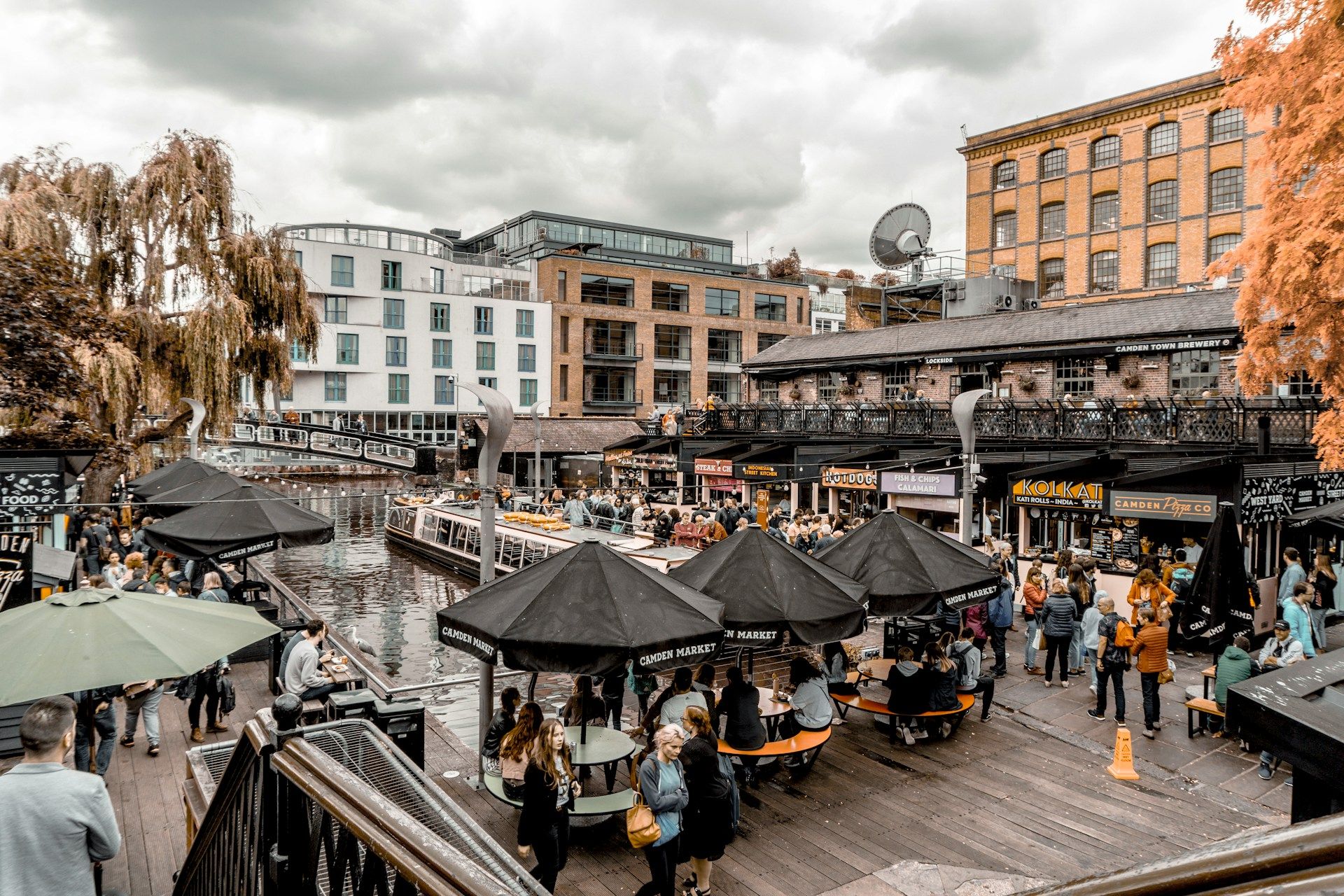
Photo by Giammarco Boscaro on Unsplash
Ask most Londoners what they think of Camden Market and they will give you a slightly complicated expression. There will be affection in it — almost everyone who grew up in or around London has a formative Camden memory, usually involving a teenage Saturday, a band t-shirt, and something fried in a paper cone. But there will also be a certain wariness. Because Camden has been declared over so many times, by so many people, that the declaration itself has become a kind of ritual.
It is the market that Londoners are always leaving and always coming back to. Which suggests it might be doing something right.
What Camden actually is
Before the nostalgia and the debate, a factual baseline: Camden Market is not one market but a cluster of them — the Lock Market, the Stables Market, the Inverness Street stalls, the Electric Ballroom flea market, Hawley Wharf. They sit on and around the Regent's Canal in a roughly coherent geography but with very different personalities. The Stables in particular has its own internal logic — the old horse hospital converted into a warren of independent stalls, the catacombs below, the horseshoe arches overhead. It is one of the few spaces in London that feels genuinely labyrinthine, where getting slightly lost is part of the experience rather than an inconvenience.
The canal runs through everything. On a still morning before the crowds arrive, the water reflects the Victorian brickwork and the painted narrowboats and the willows trailing into the channel, and it is hard not to feel that this is, quietly, one of the more beautiful urban waterways in Europe. Camden is better at dawn than it is at noon on a summer Saturday, which is true of most good things.
The market as a creative ecosystem
What Camden has always provided — even in its most commercially diluted phases — is affordable studio and retail space within reach of central London. That is rarer than it sounds and more important than it looks. The creative economy is not built primarily by large institutions and flagship galleries. It is built by the people who can find a ten-foot square unit for a price that allows them to take a risk on something new.
The jewellery makers, the leather workers, the vintage dealers who know their stock deeply, the independent perfumers, the printmakers selling work they actually made — these are people for whom Camden is not nostalgia but livelihood. The market has a whole layer of this that is invisible if you are moving through quickly, eyes on your phone, heading for the food stalls.
The food stalls, incidentally, are worth stopping for. The global food market section of the Lock has been a genuine model of diversity done well — not as a theme park version of international cuisine but as a functional, rotating cast of cooks who are actually from the places whose food they are making. You can eat your way around significant portions of the world within a two-hundred metre stretch, and the quality is consistently higher than it has any right to be given the volume of footfall the place handles.
The music question
It is impossible to write about Camden without acknowledging what it meant musically — the Dublin Castle, the Electric Ballroom, Dingwalls, the Underworld, the Roundhouse a few minutes' walk north. These are not heritage venues in the sense of being preserved for their history. They are still functioning, still discovering, still occasionally producing the kind of night that someone will describe to their grandchildren.
The Roundhouse in particular has undergone a transformation since its renovation that is worth understanding properly. It was built as a locomotive repair shed in 1847, briefly used as a gin distillery, then sat derelict for decades until the counterculture found it in the 1960s — Jimi Hendrix played there, the Rolling Stones played there, it hosted the early Notting Hill Carnival. Now it functions as one of London's most ambitious arts venues, with a particular commitment to young creatives through its studios programme that gives 18-25 year olds access to professional music, film, and circus skills facilities. The venue's history is not a weight it carries. It is something it is actively making good on.
What people get wrong about Camden
The common critique — that Camden sold out, that the big corporate landlords ruined it, that it is now just a tourist trap — has some truth in it but misses the more interesting story. Every creative neighbourhood in every major city faces the same pressure: the things that make it interesting attract people and money, which drives up costs, which eventually displaces the things that made it interesting. This is not a Camden problem. This is Shoreditch, this is Brixton, this is Williamsburg, this is Le Marais. The pattern is so predictable it is almost boring.
What is less predictable is what survives. And in Camden, what survives is the canal. The water. The physical geography that was there before the market and will be there after any particular version of it. The narrowboat community that moves slowly between London's waterways, stopping for a season and moving on. The herons that stand motionless on the towpath at five in the morning while the delivery trucks begin their routes on the road above.
Camden at its best is not the merchandise or the crowds or even the music — though the music matters enormously. It is the feeling of being in a place that has absorbed a century of London's creative energy and somehow not been entirely cleaned up or resolved into something safe. There are still corners that feel slightly ungoverned. There are still stall holders who will talk to you for twenty minutes about what they make and why they make it.
That, more than any single venue or stall or night out, is what keeps people coming back. The sense that something unscripted might still happen here. In a city that increasingly scripts everything, that is worth more than it is usually given credit for.
LondonGaze Editorial covers London's creative and cultural landscape from the inside.