How the Sunday Market Survived the Internet

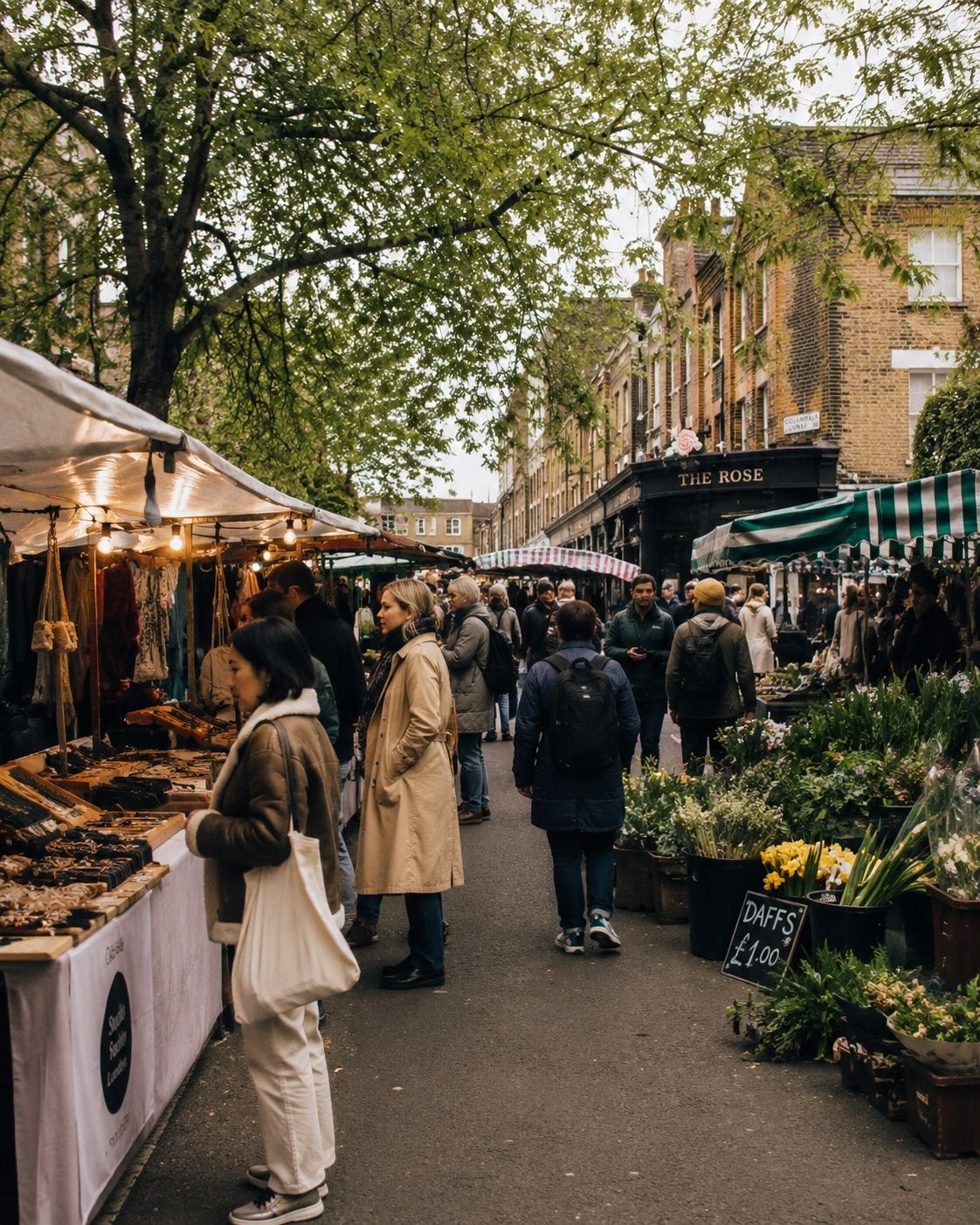
On paper, the London Sunday market makes absolutely no sense in the modern world. It is crowded, loud, and entirely dependent on the weather. You cannot filter your search, you cannot read customer reviews before buying, and if you want something, you have to physically fight your way through a wall of people to get it.
We live in an age where almost anything can be summoned to our front doors within 24 hours with a thumbprint. And yet, every Sunday morning, thousands of people still willingly subject themselves to the crush of Columbia Road Flower Market or the sprawling chaos of Brick Lane.
The craving for friction The survival of these markets is not about nostalgia. It is about a deep, growing rejection of the frictionless digital life. When every transaction we make is smooth, silent, and instantaneous, we start to crave friction. We want the loud, abrasive banter of the stallholders. We want to accidentally buy a Monstera plant that is too big for the Overground. We want the physical reality of handing over cash and carrying something home.
The digital world has optimized away the accident. Algorithms show us exactly what we already know we like. But a market is an engine for serendipity. You go looking for a coffee and end up buying a mid-century lamp, a bag of incredibly sharp knives, and a terrifying amount of cheese.
A theater of commerce The people who run these stalls understand something that e-commerce brands spend millions trying to replicate: they understand theater.
The barrow boys on Columbia Road aren't just selling peonies; they are performing. It is a specific, aggressive, deeply London kind of charm that cannot be digitized or scaled. The stallholders yelling prices, the smell of damp earth and street food, the physical exertion required just to walk down the street—it is an immersive experience.
The Sunday market survives because it offers exactly what the internet cannot. It is messy, unpredictable, and entirely human. In a city that is increasingly smoothed out and optimized, these pockets of organized chaos are not just surviving—they are essential.
LondonGaze Editorial covers London's creative and cultural landscape from the inside.